

CEREC® changes the patient experience by allowing a complete ceramic restoration—crowns, inlays, or onlays—to be planned, milled, and placed during one visit. That means fewer appointments and less time spent coordinating temporary restorations or waiting for a lab-built crown. For many patients this translates into a more efficient path back to full function and a finished smile.
Despite the speed, the process is built around predictable dental principles: careful diagnosis, precise preparation, and a controlled restorative workflow. The goal is always the same as traditional restorative care—restore form, function, and long-term health—while using modern tools to remove unnecessary delays.
Because every restoration is designed chairside, adjustments can be made in real time to address fit, bite, and esthetic concerns. That responsiveness reduces follow-up visits for small adjustments and helps patients feel confident in the final result before they leave the office.

From the patient’s perspective, a CEREC visit follows a logical, comfortable progression: evaluation and discussion, careful tooth preparation, a noninvasive digital scan, and then finishing and placement of the milled ceramic restoration. Because the digital scan replaces traditional impressions, many patients find the experience cleaner and less stressful.
While the restoration is being fabricated at the chairside, your dentist fine-tunes shade selection, contours, and occlusion. This collaborative approach gives the dentist control over both function and esthetics, and lets patients see how the restoration will blend with their natural dentition.
After placement, the restoration is polished and bonded using established adhesive techniques that promote a strong seal and healthy margins. Finally, bite contacts are checked and adjusted as necessary to ensure comfortable chewing and long-term performance.
Because the entire process is completed in-house, follow-up is straightforward: the clinician checks fit and comfort, answers any questions about care, and provides routine instructions for maintaining the new ceramic restoration.
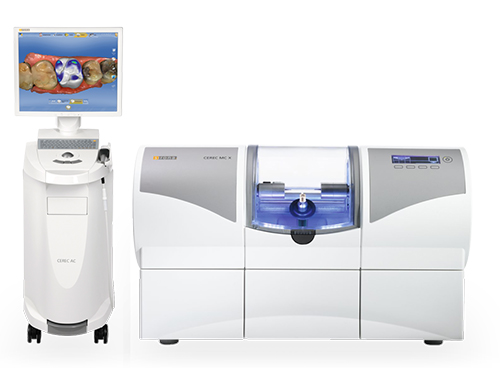
CEREC uses an integrated CAD/CAM workflow: a high-resolution intraoral scanner captures a three-dimensional model of the prepared tooth and surrounding teeth, software converts that data into a restoration design, and a chairside milling unit carves the restoration from a block of dental ceramic. Each step is driven by software and hardware engineered for clinical accuracy.
The digital model allows the clinician to evaluate margins, contact points, and occlusal relationships on-screen and make refinements before any material is milled. This virtual overview reduces guesswork and helps create a restoration that respects both the bite and neighboring teeth.
Milling technologies have advanced to the point where the ceramic blocks used are strong, color-stable, and able to accept surface characterizations. After milling, restorations are polished or glazed to achieve the desired sheen and shade match. The result is a restoration that is functional, lifelike, and tailored to the patient’s unique anatomy.
Because the laboratory step happens right in the operatory, communication is instantaneous. If a change is needed—shape, contour, or shade—the clinician can implement it immediately rather than sending notes to an off-site lab and waiting for corrections.

The ceramics used with CEREC systems are chosen to offer a blend of durability and esthetics. Modern dental porcelains and glass-ceramics provide a tooth-like translucency that integrates well with surrounding enamel while offering sufficient strength for long-term function when properly designed and bonded.
Because restorations are fabricated to the exact contours of the prepared tooth, margins can be finished precisely, which promotes healthier gum tissue and reduces the risk of food trapping. A well-fitting restoration preserves tooth structure and supports easier oral hygiene for the patient.
Clinical longevity depends on thoughtful case selection, proper preparation, and meticulous bonding protocols. When these elements are in place, CEREC restorations perform comparably to traditional lab-fabricated ceramics for many indications and provide a reliable solution for single-unit restorations.
Esthetic results are further enhanced by the ability to customize shade and surface texture at the chairside, allowing the clinician to achieve a natural look that complements a patient’s smile with fewer compromises.
Our practice emphasizes minimizing disruption to your daily life while delivering restorative care that stands up to functional demands. By integrating digital tools like CEREC, we can reduce the number of visits required and keep treatment timelines predictable. That clarity helps patients plan around their care and return to normal routines more quickly.
Beyond technology, predictable outcomes come from careful treatment planning and a focus on conservative preparation. Instead of removing extra tooth structure to accommodate an off-site process, the digital workflow supports designs that preserve as much natural tooth as possible while ensuring long-term stability.
We also prioritize clear communication. During the appointment your clinician will explain each step, show you how the restoration will look in the digital model, and answer questions about home care and follow-up. This transparent approach helps patients feel informed and involved in decisions about their care.
At Today's Dentistry San Jose, our aim is to combine proven clinical techniques with modern digital workflows so patients receive restorations that are functional, comfortable, and visually pleasing—all without multiple appointments or temporary restorations.
Whether you need a single crown, an inlay, or an onlay, CEREC offers a contemporary pathway to restorative care that is both efficient and precise. If you’d like to learn whether same‑day ceramic restorations are an appropriate option for your situation, please contact us for more information.


Today, there's no need to merely imagine how nice it would be to have a dental crown fabricated in a single visit. With CEREC technology and advanced systems of care, multiple trips to the dentist are a thing of the past! Now, one appointment is all it takes for our skilled and experienced dentist to design, fabricate, and place a naturally beautiful and long-lasting same-day crown. And, best of all, unlike conventional methods of care, you won't have to endure messy dental impressions, wear a temporary crown, or wait weeks for your permanent restoration to come back from the laboratory.
Offering a level of precision and comfort that exceeds conventional methods of care, CEREC technology is nothing short of amazing! Advanced CAD/CAM technology, which stands for computer-aided design and computer-aided manufacturing, enables our dentist to translate images from an optically scan tooth into a 3D virtual model upon which a custom crown can be digitally designed. Once this step is done, the detailed specs are then wirelessly transmitted to a chairside 3D milling machine to fabricate your new ceramic crown while you wait!
With conventional methods of care, a dental crown can take two to three visits to fabricate and place. However, thanks to the benefits of CEREC technology, we can prepare a tooth, then design, fabricate, and place your new crown, all while you wait.
With CEREC same-day crowns, there's none of the mess of conventional dental impressions, wearing dental temporaries, or waiting for the final crown to come back from the lab. Once the prepared tooth is optically scanned and the restoration digitally designed, your new crown can be milled from the highest quality of dental ceramics that very same visit.
CEREC same-day crowns and restorations are fabricated from the highest quality of dental ceramics. Because dental porcelain reflects light in much the same way as dental enamel, your new crown will look flawless, completely natural, and blend seamlessly with your smile.
A CEREC same-day crown offers much more than a convenient approach to getting a dental crown. It is also a high quality, naturally beautiful, extremely durable, and long-lasting dental restoration! The fact is, with proper oral hygiene and routine dental care your new crown will serve your smile well for many years to come.
CEREC® is an integrated CAD/CAM system that enables the design and fabrication of ceramic restorations in a single appointment. A high-resolution intraoral scanner captures a three-dimensional image of the prepared tooth and surrounding dentition, and software is used to design the restoration virtually. Once the design is finalized, a chairside milling unit carves the restoration from a precise ceramic block to match the planned contours and occlusion.
The in‑office workflow eliminates the need for traditional impressions and an off‑site laboratory for many single-unit restorations. Because design and milling happen chairside, the clinician can make real‑time adjustments to fit, bite, and esthetics before finishing and bonding the restoration. This direct feedback loop improves predictability and reduces the number of appointments required to complete treatment.
CEREC® is commonly used to fabricate single crowns, inlays, onlays, and certain veneers that require precise ceramic work. The system is particularly well suited for restorations that benefit from a conservative approach, allowing clinicians to preserve more natural tooth structure when compared with aggressive preparations. Its flexibility also supports repairs and replacement of existing ceramic restorations when appropriate.
Case selection is important: CEREC® excels for single‑unit posterior and anterior restorations where strength, fit, and esthetics are priorities. For more complex multi‑unit or implant‑supported prostheses, clinicians may still rely on specialized laboratory workflows that are better matched to those indications. Your dentist will recommend the best pathway based on functional demands and long‑term prognosis.
A typical CEREC® visit begins with a clinical evaluation and discussion of the treatment plan, followed by careful tooth preparation and a digital scan. While the restoration is being designed and milled at the chairside, the dentist will finalize shade selection and refine contours to blend with adjacent teeth. Once milled, the restoration is finished, polished or glazed as needed, and then bonded using established adhesive protocols.
Throughout the appointment clinicians check margins, contacts, and occlusion to ensure comfort and function before the patient leaves. Because the restoration is completed that day, there is no need for a temporary crown or a second appointment for final seating in many cases. After placement, the dentist will provide instructions for home care and schedule any routine follow‑up to confirm fit and comfort.
Digital scanning captures a three‑dimensional model of the mouth using an intraoral scanner, replacing putty or tray impressions in many restorative cases. Scanning is generally cleaner and faster, and it eliminates distortion and material handling issues associated with physical impressions. The digital model can be evaluated on screen immediately, allowing the clinician to assess margins, contacts, and occlusal relationships before fabrication begins.
Because the digital workflow provides instant visualization, adjustments can be made virtually to optimize fit and esthetics prior to milling. This reduces the trial‑and‑error often associated with sending physical impressions to a lab and waiting for a return restoration. For patients the experience is typically more comfortable and less time consuming than conventional impression techniques.
When selected and executed correctly, CEREC® ceramic restorations offer durability comparable to many lab‑fabricated ceramics for single‑unit indications. Material science improvements have produced ceramic blocks with favorable strength and color stability that, when combined with proper preparation and adhesive bonding, support long‑term function. Clinical longevity depends on appropriate case selection, occlusal management, and adherence to precise bonding protocols.
Maintenance and oral hygiene play a significant role in long‑term success; well‑fitting margins and proper contours support healthier gum tissue and reduce plaque accumulation. Regular dental checkups allow clinicians to monitor restorations for wear, marginal integrity, and occlusal changes so they can intervene early if adjustments or refinements are needed. With conservative preparation and meticulous technique, many patients enjoy years of reliable service from chairside‑fabricated ceramics.
Shade selection and surface characterization are integral parts of the CEREC® workflow and are addressed chairside for immediate refinement. The clinician evaluates color, translucency, and texture in the patient’s mouth and can adjust the digital design or select a ceramic block that best matches adjacent teeth. After milling, restorations may be stained, glazed, or polished to enhance surface character and achieve a lifelike appearance.
Because adjustments occur in real time, the dentist can fine‑tune contours and contacts to ensure the restoration blends seamlessly with the natural dentition. This hands‑on approach allows for close coordination between function and esthetics and helps patients leave the appointment with a restoration that looks and feels integrated. Final polishing and glazing further refine the surface sheen for long‑term color stability.
CEREC® restorations are milled from high‑quality ceramic and glass‑ceramic blocks engineered for strength, esthetics, and color stability. These materials mimic the translucency and light‑reflective properties of natural enamel while offering the durability needed for everyday function. Different ceramic formulations are selected based on the restoration’s location, occlusal load, and esthetic requirements.
The material choice also affects finishing options: some ceramics accept surface characterization and glazing, while others are polished to achieve the desired sheen. Clinicians choose blocks that balance fracture resistance with cosmetic goals and then design restorations to conserve tooth structure and distribute occlusal forces appropriately. Proper adhesive bonding further enhances the strength and integration of the restoration.
Good candidates for CEREC® are patients needing single‑unit restorations such as crowns, inlays, or onlays who value a streamlined, same‑day solution. Candidates should have healthy surrounding teeth and gums and a bite that can be predictably managed with a single‑unit ceramic restoration. Patients with heavy bruxism, extensive multi‑unit needs, or complex implant prosthetics may require alternative workflows better suited to those indications.
Your dentist will evaluate oral health, restorative needs, and functional demands to determine whether a chairside ceramic restoration is the best option. Clinical factors such as remaining tooth structure, occlusal forces, and esthetic expectations guide the decision. When the indication is appropriate, CEREC® offers an efficient and precise pathway to restore form and function in a single visit.
Bonding protocols for CEREC® restorations follow evidence‑based adhesive techniques that create a strong, durable interface between the ceramic and tooth structure. Proper isolation, surface treatment of the ceramic, and adhesive selection are critical steps that contribute to marginal integrity and resistance to microleakage. When these protocols are executed meticulously, the restoration can distribute functional loads effectively and protect remaining tooth structure.
After placement, clinicians verify occlusion and make any necessary adjustments to reduce localized stress and prevent premature wear or fracture. Postoperative guidance on oral hygiene and routine examinations helps detect early signs of wear or marginal breakdown so interventions can be performed before major issues develop. Combined with conservative preparation and precise fit, reliable bonding is a cornerstone of long‑term performance.
At Today's Dentistry San Jose we combine modern digital workflows with a patient‑centered approach to deliver predictable, same‑day ceramic restorations. Our chairside design and milling capabilities allow clinicians to control fit, occlusion, and esthetics directly in the operatory, reducing the need for temporary restorations and multiple visits. We emphasize conservative preparation and evidence‑based bonding to support durable outcomes and healthy margins.
Patients can expect clear communication throughout the process, from virtual design review to final placement and maintenance instructions. By pairing advanced technology with careful case planning, our team aims to restore function and appearance efficiently while prioritizing long‑term oral health. If you have questions about whether CEREC® is right for your restorative needs, our office can evaluate your situation and explain the options available.

Ready to schedule your next dental appointment or have questions about our services?
We’re ready whenever you are. Whether you have a quick question about a treatment or you're set to book your next visit, our team makes getting in touch effortless. Give us a call, drop an email, or use the form below to start a conversation. Your path to a healthier, more confident smile is just a message away—reach out today and let’s discuss how we can help.

Back to top
